
Guide
Cracks in walls: when to worry and when not to
Reviewed
Most cracks are cosmetic. The ones that are not tend to announce themselves in a particular way.
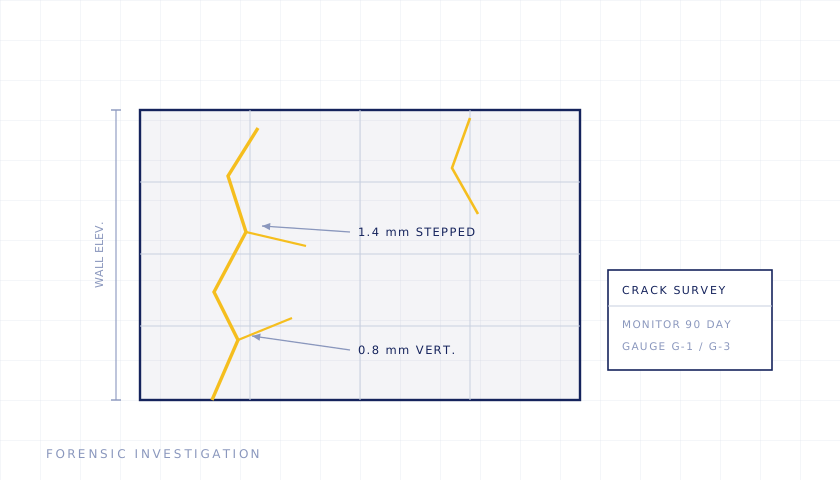
Almost every house cracks. Materials shrink as they cure, timber moves with humidity, and buildings settle. The overwhelming majority of what people find alarming is cosmetic. But a small proportion of cracking is telling you something about the structure, and the difference is usually readable from the pattern rather than from the size.
Three things matter: where the crack is, which direction it runs, and whether it is changing.
Where it is
Drywall and plaster cracks are the most common and the least significant. Typical locations are the corners of doors and windows, where the board has been cut around an opening, and along joints between sheets. Hairline cracking here is usually shrinkage and normal movement.
Masonry and brick cracking matters more, because masonry has almost no ability to accommodate movement. A crack through brickwork means something has moved enough to break it.
Foundation cracking is where a proper assessment is most often warranted. Poured concrete foundations frequently develop vertical shrinkage cracks within the first year and those are usually benign. Cracks that are wide, that step diagonally, that run horizontally, or that show one side displaced relative to the other are a different category.
Which direction it runs
- Vertical, hairline, in poured concrete. Very common, usually shrinkage during curing. Rarely structural. Can still admit water, which is a separate problem worth solving.
- Diagonal from the corner of an opening. Doors and windows are weak points, and short diagonal cracks there are frequently normal. Long diagonals crossing multiple courses of masonry are worth attention — they usually indicate differential movement between one part of the building and another.
- Stair-step cracking through mortar joints. The classic signature of differential settlement in masonry. One part of the wall has moved relative to another. This is the pattern that most reliably indicates a foundation issue.
- Horizontal cracking in a foundation wall. The one to take seriously. In a basement wall it frequently indicates lateral pressure from soil and water outside — the wall being pushed inward rather than settling downward. Combined with any inward bowing, this warrants prompt assessment.
- Cracking with displacement. Where one side of the crack sits proud of the other, or the crack is wider at one end than the other, movement has occurred in more than one plane. Width alone matters less than offset.
Whether it is changing
A stable crack and an active crack are different problems, and the distinction is often more useful than the crack’s size. A wide crack that has not moved in twenty years is generally less concerning than a narrow one that has appeared in the last three months.
The usual way to establish this is monitoring — marking the ends of the crack and dating them, or fitting a simple gauge across it, then observing over a period that spans seasonal change. Buildings move with temperature and ground moisture, so a monitoring period that covers a wet season and a dry one gives a far more useful answer than a single visit.
Photographs with a scale in frame and a date are worth taking whether or not you engage anyone. If it does become a matter for a report, an insurance claim or a sale, that record is the most valuable thing you can have.
Signs that warrant a prompt look
None of these mean a building is unsafe. They mean the question should be answered rather than assumed:
- Horizontal cracking in a foundation wall, particularly with any inward bow
- Stair-step cracking through masonry that continues across several courses
- Cracks where one side is displaced out of plane relative to the other
- Doors and windows that have started binding, or floors that have developed a noticeable slope
- Cracking that appeared suddenly, or has visibly widened over weeks rather than years
- Cracking after an event — nearby excavation, a vehicle impact, a storm, a flood, a leak that saturated the ground next to a foundation
- New cracking above a wall that was opened up in a previous renovation
That last one comes up more often than people expect. A wall removed years ago without adequate support, or with a beam that was undersized, can produce cracking above it long after the work was done.
What causes the ones that matter
Structural cracking is almost always a symptom rather than a cause. The usual underlying reasons:
- Differential settlement. One part of the foundation has settled more than another, often because of variable soil, a poorly compacted fill area, or an addition founded differently from the original house.
- Lateral soil pressure. Saturated soil against a basement wall, sometimes made worse by poor surface drainage, downspouts discharging at the foundation, or a driveway surcharge.
- Inadequate or altered load path. A beam, header or post that is undersized, or a support that was removed.
- Water. A persistent leak that undermines bearing soil, or freeze-thaw action in saturated masonry.
- Deflection. Framing spanning further than it should, producing cracking in the finishes attached to it.
Filling a crack without establishing which of these applies treats the symptom. If the cause is active, the repair cracks again.
What an engineering assessment involves
Measuring the cracking and recording its pattern, direction and any displacement. Checking the foundation, the framing and the load path for the mechanism that would produce that pattern. Looking at drainage, grade and anything nearby that could be loading the soil. Where relevant, opening a test pit to see the footing, or taking levels across a floor to quantify differential movement.
The output should tell you three things: what is causing it, whether it is active, and what — if anything — the structure requires. Sometimes the honest answer is that it is cosmetic and should be filled and forgotten. That answer is worth having in writing, particularly if you are selling.
Common questions
How wide does a crack have to be before it is a problem?
Width is a weaker signal than most people assume. A wide, stable, vertical shrinkage crack in a poured foundation is usually benign, while a narrow horizontal crack in a basement wall can be significant. Direction, location and whether the two sides are displaced tell you far more than width — and whether it is still moving matters more than all of them.
The crack appeared after a storm. Does that change things?
It makes it worth looking at sooner. Sudden cracking following an event — a storm, a flood, nearby excavation, an impact — suggests something changed rather than something gradual. It also matters for documentation: if there is any prospect of an insurance claim, recording the condition early and with a date is considerably more useful than reconstructing it later.
Can I just fill it?
If it is cosmetic, yes. If it is active, the filler will crack again, because the movement causing it has not stopped. That is the practical reason to establish the cause first — not because every crack is serious, but because filling an active one wastes the work and hides the evidence.
Will a crack stop my house selling?
Rarely on its own, but it can stall a transaction if a home inspector flags it and nobody can say what it is. A short sealed engineering opinion stating the cause and whether it is structural usually resolves that faster and more cheaply than negotiating in the dark.
Related services
- Structural Engineering
- Forensic Engineering
- Inspections & Site Observation
- Engineering Reports & Certifications