
Guide
What a property file review tells you before you buy
Reviewed
The municipal record holds things a walkthrough and a home inspection will not surface.
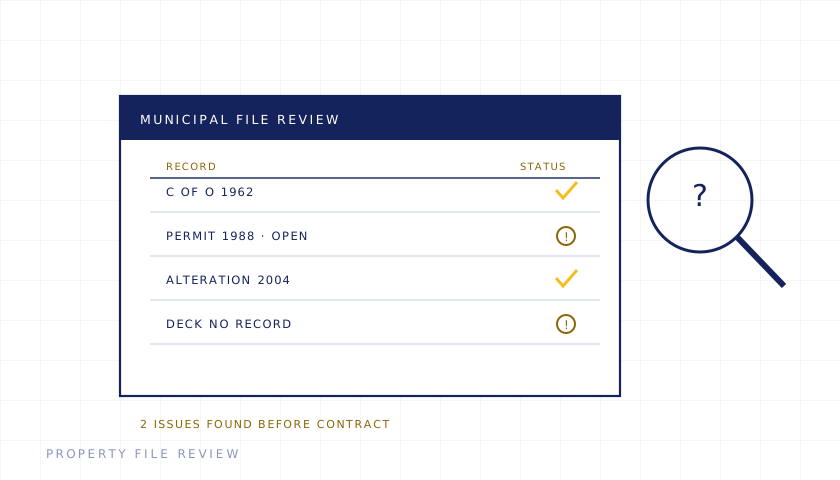
Three separate enquiries get run on a property before a sale, and most buyers order two of them. The survey establishes boundaries. The home inspection assesses physical condition. The title search examines ownership and encumbrances.
None of them reads the building department file — and that is where the problems that cost money after closing generally live.
What is actually in the file
Every property has a record at whichever department holds it. Depending on the age of the house and the jurisdiction, it may contain the original construction permit and approved plans, every subsequent permit issued, the inspection sign-offs against each one, the certificate of occupancy, violation and complaint history, and any survey or plot plan filed along the way.
What matters as much as the contents is the gaps. An addition visible on the survey and absent from the file. A permit issued in 1998 with no final inspection recorded against it. A certificate of occupancy describing a one-family dwelling in a house currently arranged as two.
What it surfaces
- Open permits. Issued, never signed off. The record still shows work in progress, sometimes decades later. Title companies take exception to them; lenders may decline to fund against them.
- Expired permits. Lapsed before completion, which may require refiling under current code rather than the code that applied when issued.
- Unpermitted work. Nothing filed at all — the finished basement, the converted garage, the deck, the second kitchen. This is a legalization, not a sign-off, and a longer exercise.
- Certificate of occupancy problems. Absent, or present but no longer describing the building.
- Violations. Open enforcement actions, sometimes with penalties accruing.
- Zoning non-conformity. Whether the building complies with current zoning, and if not, whether it is legally pre-existing — which decides what a future owner can and cannot do.
That last one is frequently the most valuable finding for a buyer with plans. A property that cannot be extended without a variance is a different investment from one that can.
Why the home inspection does not cover it
A home inspector assesses what is physically there against a general standard. They are not looking at the municipal record and are not expected to.
An inspector can tell you the finished basement is well built. They cannot tell you it was never filed, that its ceiling height means it cannot be legalized, or that the certificate of occupancy does not cover it. Those are record questions, and they determine what the property is legally permitted to be — which is what affects value, financing and insurability.
Why it is not a title search either
A title search examines ownership, liens and encumbrances. A file review examines what the building department has approved. A property can return a perfectly clean title report and carry three open permits and an unfiled apartment. They answer different questions and neither substitutes for the other.
What the report gives you
What the record shows, what is missing, what is physically present that should be on file and is not, and an assessment of what resolving each item would take in effort and time.
That last element is what makes it a decision-making document. “There is an open permit” is information. “There is an open permit for a rear deck, the deck as built is larger than what was approved, and closing it means an as-built filing and a re-inspection” is something you can price, negotiate against, or walk away from.
Timing decides what it is worth
Run before a contract, the findings are a negotiating position — a price adjustment, a seller obligation, or grounds to withdraw. Run after signing, they are your problem. Run after closing, they are your problem and your cost.
A property under contract accrues taxes, insurance, utilities and interest every day it sits, which is why the review is structured to be quick — days rather than weeks — so it fits inside a due diligence period rather than extending one.
When it is worth running on a property you already own
Before listing. The findings are the same; the difference is who controls the timetable. An issue you discover with six months before listing is a project. The same issue discovered by a buyer’s attorney with three weeks to closing is an escrow holdback and a discount.
Common questions
How long does a file review take?
Usually a matter of days rather than weeks — it is a records and comparison exercise, not a design one. The variable is the jurisdiction, because departments differ in how they hold and release records, and older files are sometimes only available in physical form.
Is this the same as a title search?
No. A title search covers ownership, liens and encumbrances. A file review covers what the building department has approved — permits, sign-offs, certificates and violations. A clean title report and a problematic building file routinely coexist on the same property.
Can you review a property I have not bought yet?
Yes, and that is the point at which it is most useful. The building department record is public, so it can be examined before a contract while the findings can still affect price or terms.
What if the review finds something serious?
Then you know before you are committed, which is the entire value. Most findings are resolvable — the question is what it costs and how long it takes, and the report is written to answer that rather than just to list the problem.
Related services
- Property File Review
- Violations, Open Permits & Compliance
- Certificates of Occupancy & Compliance
- Legalizations