
Guide
Legalizing an accessory apartment on Long Island
Reviewed
What determines whether an existing second unit can be brought onto the record.
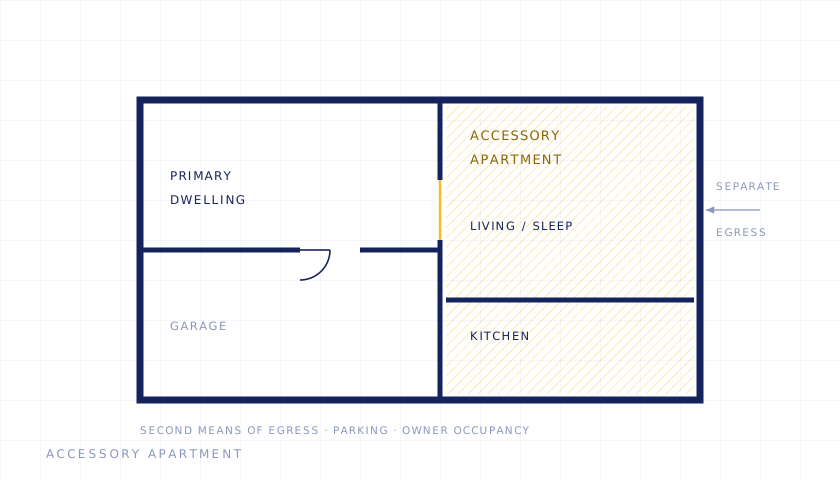
Second units are among the most common unpermitted conditions on Long Island. A basement finished for a relative. A garage converted years ago. A mother-daughter arrangement that was never filed. They surface at sale, at refinance, or when a neighbour makes a complaint.
There are two separate questions, and they fail independently
People tend to ask “can this be legalized?” as one question. It is two, and a unit has to clear both.
- Does the zoning permit an accessory apartment on this property at all? This is a legal question about the district, the lot and the owner. If the answer is no, the physical condition of the space is irrelevant.
- Can the space as built meet the requirements for habitable, separately occupied area? This is a building code question about ceiling height, egress, light, ventilation and fire separation.
Most failures are on the second. Most surprises are on the first.
The zoning side
Accessory apartment rules are set locally, and neighbouring jurisdictions take genuinely different positions on the same question. Two properties a mile apart can face entirely different requirements. What usually gets examined:
- Whether the district permits it. Some allow accessory apartments as-of-right in certain residential districts, some by special permit, some not at all.
- Owner occupancy. Many jurisdictions require the owner to live on the property. This is the requirement that most often ends an investor’s plan.
- One per lot. A second accessory unit is generally not permitted regardless of lot size.
- Minimum lot area and floor area. Both a floor on the lot and frequently a ceiling on the unit — often expressed as a maximum percentage of the total floor area, or a maximum number of bedrooms.
- Parking. Additional off-street spaces are usually required, and on a narrow lot with an existing driveway this can be the binding constraint.
- Registration and renewal. Several jurisdictions require the permit to be renewed periodically and inspected on renewal, rather than granting it once permanently.
Accessory apartment, mother-daughter, two-family — not interchangeable
These are distinct legal categories and using the wrong term leads people to the wrong answer.
- An accessory apartment is a subordinate second unit within a one-family house, permitted under specific conditions, usually including owner occupancy.
- A mother-daughter arrangement generally describes an accessory unit occupied by a family member, sometimes with a permit that lapses when the family member no longer lives there.
- A two-family dwelling is a different use classification entirely, permitted only in districts zoned for it, with different code requirements throughout — separation, egress, and frequently sprinklers.
A house cannot be converted from the first to the third simply by wanting it to be. The district decides.
The building code side
Assuming the zoning permits it, the space itself has to comply. In rough order of how often each one kills a project:
- Ceiling height. Habitable rooms require a minimum clear height — commonly seven feet, with limited allowance below beams and ducts. In a basement this is very often the item that decides it, and it is the hardest to fix, because the remedies are underpinning or lowering the slab.
- Egress. A second means of escape from the unit and from every sleeping room. Where that is a window it has to meet minimum net clear opening area, minimum width and height, and a maximum sill height above the floor. In a basement it usually means a proper egress window and window well, which means cutting the foundation wall — achievable, but it is structural work with a lintel and a real cost attached.
- Light and ventilation. Glazed area and openable area, each expressed as a percentage of floor area.
- Fire separation. Rated separation between the units, and between any part of the dwelling and an attached garage, including self-closing rated doors and correct penetration detailing.
- Smoke and carbon monoxide alarms. Interconnected, in the required locations, throughout the whole dwelling rather than only in the new unit.
- Heat, and separate utilities where required.
- Sanitary capacity. In unsewered parts of Suffolk this is not a footnote. Adding a unit or a bedroom changes the sanitary demand, which brings county health department review into the project, and that review frequently takes longer than the building department’s.
Basement, garage or above the garage — different problems
Basements fail on ceiling height and egress more than anything else. Everything else is usually solvable.
Converted garages raise a different set: whether the required parking still exists once the garage is gone, whether the slab and foundation were built for habitable use, insulation and frost protection at the perimeter, and the fire separation that was never there because the space was a garage.
Space above a garage is often the most straightforward physically — height and egress are usually fine — but it raises the separation requirement over the garage below, and it can run into accessory-structure or height limits in the zoning.
How the work actually proceeds
A site visit and a property record search come first, together. The record establishes what the municipality thinks is there; the visit establishes what is actually there. Between them you learn which of three situations applies: it can be filed substantially as-built, it can be filed after specific modifications, or it cannot be legalized at this property under the current zoning.
That third outcome is worth knowing early. It is not a good answer, but it is a cheap one, and it is far better than discovering it after money has been spent on drawings.
The cost of leaving it
An unpermitted unit does not become permitted with time. It does become steadily more expensive to ignore:
- At sale. The house is marketed as what the record says it is. An unpermitted unit either comes off the listing or comes off the price.
- At refinance or appraisal. Rental income from an illegal unit generally cannot be counted.
- On insurance. A claim involving an unpermitted, non-compliant unit is a claim an insurer has grounds to contest.
- On complaint. Enforcement is usually complaint-driven, and once a violation is issued you are working to the municipality’s deadline rather than your own, with penalties that can accrue while you do.
The asymmetry is the point. Legalizing on your own timetable is a project. Legalizing under a violation notice, or under a contract of sale, is the same project done faster and more expensively.
Common questions
Can any basement apartment be legalized?
No, and ceiling height is usually why. Habitable rooms need a minimum clear height, and a basement that falls short can only be fixed by lowering the slab or underpinning — both substantial structural work that often costs more than the unit is worth. Egress is the second most common blocker, though that one is more often solvable.
Do I have to live in the house?
In many Long Island jurisdictions, yes — owner occupancy is a standard condition of an accessory apartment permit. It is the requirement that most often ends the plan for an investor buying a house for the rental income. Because it is set locally, it has to be checked against the specific jurisdiction rather than assumed.
What is the difference between an accessory apartment and a two-family house?
A different use classification, not a different description of the same thing. An accessory apartment is a subordinate unit inside a one-family house, allowed under specific conditions. A two-family dwelling is only permitted in districts zoned for it and carries different code requirements throughout. You cannot convert one into the other by choice — the zoning district decides.
The apartment has been there for thirty years. Does that make it legal?
No. Unlike some non-conforming conditions, an unpermitted use does not become lawful through the passage of time. It stays exactly as unpermitted as the day it was built, and it surfaces the moment anyone with a financial interest looks at the record.
What happens if a neighbour complains?
Enforcement on Long Island is largely complaint-driven, so a complaint is often what starts the process. A violation is issued with a deadline for correction, and penalties can accrue while it is outstanding. You end up doing the same legalization work, but on the municipality’s schedule instead of your own.
Related services
- Accessory Apartments & Conversions
- Legalizations
- Certificates of Occupancy & Compliance
- Variances & Zoning Relief