
Service 10
Legalizations
Bring existing work onto the record and resolve open permits and violations.
Work built without a permit surfaces eventually — at sale, at refinance, or after a complaint. Resolving it means documenting what exists, testing it against current code and zoning, and filing a set the municipality can approve.
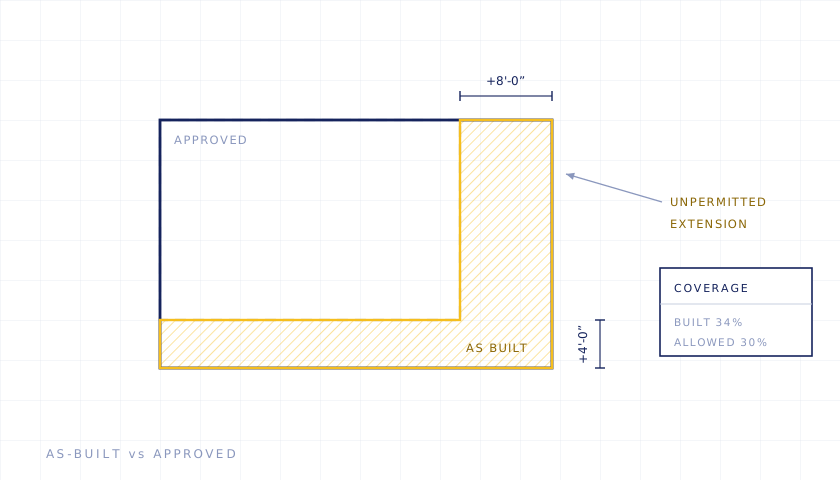
The sequence is always the same
Pull the municipal record. Measure what is physically there. Compare the two. That comparison is the whole exercise — everything after it follows from the size of the gap.
The record establishes what the municipality believes exists and what it has approved. The site visit establishes reality. Between them the project resolves into one of three outcomes, and knowing which one applies before any drawings are produced is what keeps the cost proportionate.
Three possible outcomes
- It can be filed substantially as-built. The work complies, or complies closely enough that it can be documented and approved as it stands. This is more common than people expect, particularly with additions and decks.
- It can be filed after specific modifications. Something identifiable has to change first — egress, a railing, a smoke alarm arrangement, a structural member that needs reinforcement. The filing follows the correction.
- It cannot be legalized at this property under the current zoning. The use is not permitted in the district, or a dimensional requirement cannot be met and relief is not realistic. This is not a good answer, but it is a cheap one when it arrives early.
Where it gets expensive
The items that turn a straightforward legalization into a substantial project are reasonably predictable:
- Ceiling height in basement space, because the remedies are lowering the slab or underpinning
- Egress where a compliant window means cutting a foundation wall — achievable, but it is structural work with a lintel attached
- Concealed work that cannot be inspected without opening finished surfaces, or that has to be evaluated and certified by an engineer instead
- Sanitary capacity in unsewered parts of Suffolk, where added bedrooms bring county health department review into the project and often set the outer date
- Parking, where a converted garage removed the spaces the zoning still requires
Doing it before you are forced to
Unpermitted work does not become permitted through the passage of time. It does become more expensive to ignore. Resolved voluntarily, it is a project on your schedule with a scope you control. Resolved under a violation notice or a contract of sale, it is the same technical work compressed into someone else’s deadline, usually with a penalty or an escrow holdback attached.
Scope
- Field measurement and as-built documentation
- Code and zoning analysis of existing work
- Determination of what can be legalized as-is
- Legalization filings and permit issuance
- Basement, attic and accessory space legalization
- Deck, dormer and addition legalization
- Inspection coordination and final sign-off
Who we work with
Owners, investors, property managers, attorneys and title companies.
Where we deliver this
Across Nassau, Suffolk, the East End and all five boroughs. Most requested in:
Related services
- Violations, Open Permits & Compliance
- Accessory Apartments & Conversions
- Certificates of Occupancy & Compliance
- Property File Review
- Variances & Zoning Relief
- Structural Engineering
Related guides
Common questions
Can everything be legalized?
No. Some conditions can be filed as-is, some need modification first, and a few need a variance. The analysis tells you which.
Will legalizing raise my taxes?
Adding legal living area can affect assessment. That is worth weighing against the cost of leaving it unresolved at sale.
How long does a legalization take?
The measurement and analysis stage is usually a matter of weeks. What varies is what comes after — a straightforward as-built filing moves at the pace of the department, while a legalization requiring physical modification, county health review or a variance application runs considerably longer. You will get a realistic range for your specific situation once the record and the site have been looked at.
Will legalizing trigger an inspection of the whole house?
Generally the scope of review follows the scope of the filing rather than expanding to the entire property. That said, an inspector on site who sees an unrelated obvious hazard is not obliged to ignore it. Where there is other unpermitted work, it is usually better to identify it up front and decide deliberately how to handle it than to have it discovered.