
NASSAU COUNTY
Engineering & Permitting in Hempstead
Sealed engineering, construction documents and filings for property in the Town of Hempstead and the villages inside it.
The Town of Hempstead is the most populous township in the United States, and it contains more incorporated villages than any other town on Long Island. That single fact governs almost everything about how a filing here is prepared.
The first question is always which department holds the file
An incorporated village — Rockville Centre, Freeport, Lynbrook, Garden City, Valley Stream, Malverne, Island Park, Hempstead Village and the rest — runs its own building department, its own zoning code and its own board of appeals. The unincorporated areas fall to the Town of Hempstead Building Department. These are not variations on one process. Setback tables, coverage limits, submission formats and fee schedules all differ, and a set assembled for the Town will not be accepted across a village counter.
Property owners frequently do not know which category they are in, because the mailing address does not settle it. Establishing jurisdiction before anything is drawn is not administrative housekeeping here — it determines the zoning analysis the design has to satisfy.
Design conditions
Most of Hempstead is sewered, through the county system, so sanitary disposal is rarely the item that sets the schedule. That is a meaningful difference from Suffolk, where health-department sanitary review routinely drives the critical path.
The south shore is the constraint instead. Substantial portions of Freeport, Baldwin, Oceanside, Island Park, Bay Park, East Rockaway and Lido are mapped in FEMA special flood hazard areas, which brings the flood-resistant construction provisions of the state code into play — lowest floor elevation, flood venting, breakaway construction, and equipment set above the design flood elevation. Design wind speeds also run higher along the shoreline than a few miles inland; the governing value is the one the hazard maps return for the specific parcel, not a town-wide figure.
What comes up most often here
- Accessory apartments and basement conversions that were never filed
- Open permits and missing certificates surfacing during a contract of sale
- Dormers, rear additions and second-story work on tight lots where coverage governs
- Decks, pools and sheds built without permits, discovered at survey
- Village-level variance applications where the existing condition is already non-conforming
Filing in the Town of Hempstead
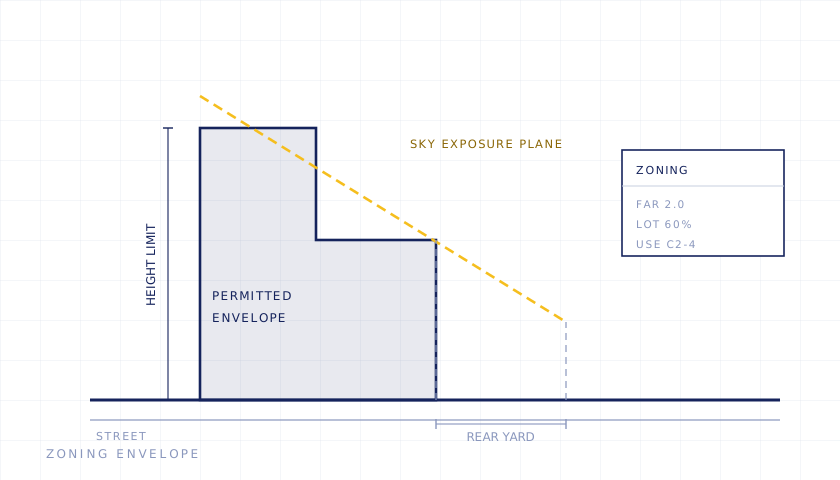
There is no single Hempstead counter. An incorporated village runs its own building department under its own code, and everything outside them goes to the Town. Which one holds your file is settled from the tax map before a drawing is started, because the setbacks, the coverage limits, the fee schedule and the submission format all follow from that answer.
What generally has to be in hand before an application is useful: a current survey showing the building as it actually sits, the certificate of occupancy on file, and the permit history for anything already built. On a property with unfiled work, that history is the item that determines whether this is a permit application or a legalization.
Because most of the town is sewered, sanitary disposal rarely drives the schedule here. The controllable variable is submission completeness — a set that answers the department’s standing questions the first time avoids the objection cycle, and each cycle costs weeks rather than days.
We prepare and file with these departments. We are not the department, and nothing here is an official municipal source — confirm current requirements with the authority itself.
Services most used in Hempstead
- Legalizations
- Accessory Apartments & Conversions
- Violations, Open Permits & Compliance
- Certificates of Occupancy & Compliance
- Property File Review
- Additions & New Construction
- Variances & Zoning Relief
- Structural Engineering
Common questions about Hempstead
My address says Hempstead — is my property in the Town or in a village?
It has to be checked; the mailing address does not answer it. If the property sits inside an incorporated village, that village’s building department and zoning code apply and the Town has no role. This is confirmed from the tax map and the village boundary before any drawing starts, because the applicable setbacks and coverage limits follow from it.
Can an accessory apartment in Hempstead be legalized?
Often, but it depends on the zoning district, the ceiling heights, the egress arrangement, the fire separation and whether the parking and lot area requirements can be met. The honest sequence is a site visit and a property record search first, because that establishes whether the path is a straight filing, a filing after modification, or a variance application.
How do I find out whether there are open permits on a Hempstead property?
Through a property file review — the municipal record is pulled from whichever department holds it, and compared against what is physically there. On a south shore property this normally also surfaces post-storm work that was carried out without a filing.
Related guides
- Engineering & permitting across Nassau County
- Long Island building departments: who holds your file
- Can my house support a second story?
- What an open permit is, and how it gets closed
- Legalizing an accessory apartment on Long Island
- What a property file review tells you before you buy
- What to do when you get a violation
Getting started
The first step is establishing which department holds the file and what the municipal record actually shows. That is one conversation, and it usually changes what the project looks like.
Scope and pricing confirmed before work begins.