
Guide
What an open permit is, and how it gets closed
Reviewed
Why a permit pulled decades ago can stop a sale today, and what resolving it involves.
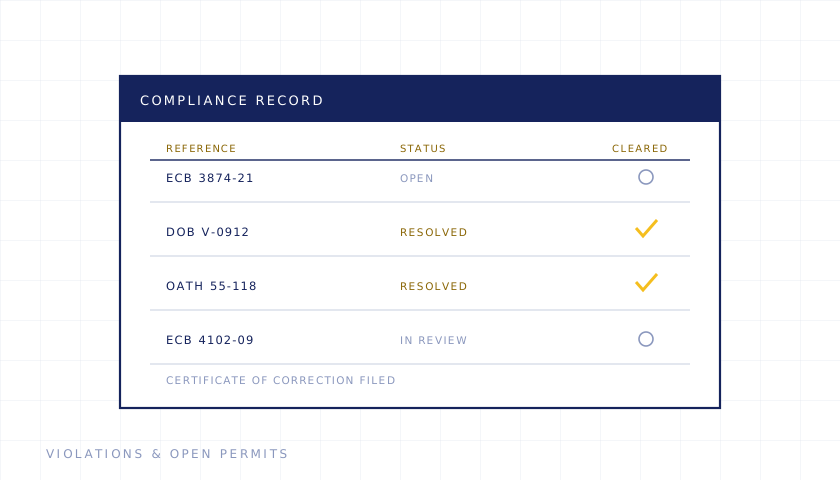
An open permit is one that was issued but never signed off. The work may have been finished thirty years ago; as far as the municipality is concerned, it is still in progress. Nobody notices until somebody looks — and the person who looks is usually a buyer’s attorney or a title company, three weeks before a closing.
Open permit, expired permit, unpermitted work — three different problems
These get used interchangeably and they are not the same thing. The distinction decides what the fix looks like.
- An open permit means a permit was issued, work began, and the final inspection and sign-off never happened. The record shows an incomplete job.
- An expired permit means the permit lapsed before the work was completed or inspected. Depending on the jurisdiction it may be renewable, or it may have to be refiled from the start under whatever code is current now rather than the code that applied when it was issued.
- Unpermitted work means nothing was ever filed. There is no permit to close — there is a legalization to pursue, which is a longer exercise.
It is common to find more than one on the same property, and it is common for an open permit investigation to surface unpermitted work nobody was looking for.
Why it stops a deal
An open permit is an unresolved liability attached to the property, not to whoever pulled it. Buying the house means buying the open permit. That is why the parties who care are the ones protecting a financial interest:
- Title companies flag it as an exception, which means they will not insure over it.
- Lenders may decline to fund, particularly where the open permit relates to structural work or where it puts the certificate of occupancy in question.
- Buyers’ attorneys will want it addressed before closing, most often through an escrow holdback — money withheld until the sign-off is produced, with the seller carrying the cost and the deadline.
The secondary problem is the certificate of occupancy. If the open permit covered work that changed the building — an addition, a conversion, a structural alteration — the certificate on file may no longer describe the building accurately, and closing the permit becomes part of a larger correction.
How they happen in the first place
Almost never through bad faith. The usual causes are mundane:
- The contractor finished, got paid and moved on without calling the final inspection
- The work was substantially complete but one trade — usually electrical — was never signed off
- The owner sold or the contractor went out of business mid-job
- An inspection was failed, corrections were made, and nobody called the re-inspection
- The department migrated to a new records system and partial records carried over
- The job was genuinely abandoned and the structure altered anyway
What closing one actually takes
The sequence is consistent even when the difficulty is not.
- Pull the file. Establish what the permit covered, what drawings were approved, which inspections were signed and which were not. This is a records exercise and it is where most of the useful information is.
- Inspect what was actually built. Measure it. The approved drawings and the physical building are frequently not the same, and the size of that gap governs everything downstream.
- Reconcile the two. Where they match, the route is to schedule the outstanding inspections and obtain the sign-off. Where they do not, the built condition has to be documented and tested against the code that applies now.
- File what the department needs. That may be as-built drawings, a sealed letter, a structural certification, or a full amended filing, depending on the scope and the jurisdiction.
- Obtain the sign-off and, where the certificate of occupancy is affected, the updated certificate.
The cases that take longer
- The contractor who pulled the permit is gone and the inspection records are incomplete
- The work no longer complies with current code, so it cannot simply be inspected and signed
- The permit was pulled for one scope and a different scope was built
- Concealed work — framing, electrical, plumbing — that cannot be inspected without opening up finished surfaces, or that has to be certified by a professional engineer instead
- Additional unpermitted work is discovered during the inspection
- The property has changed hands since, and the current owner has no records at all
Concealed work is the one that surprises people most. Where an inspector cannot see what was done, the options are to expose it or to have it evaluated and certified by a licensed engineer. The second is usually cheaper than the first.
It is not the same everywhere
On Long Island the process is set by whichever authority holds the file, and that is the first thing to establish — an incorporated village runs its own building department and its own records, entirely separately from the town around it. Two properties a mile apart can face different procedures, different documentation requirements and different timelines.
In New York City the equivalent problem is an open application or a permit without a sign-off in the Department’s records, resolved through the job’s own close-out path — and depending on the job type, that ends in either an updated certificate of occupancy or a letter of completion. City records also go back further and are more likely to contain legacy entries from superseded filing systems.
What to do if you are selling
Check before you list, not after you are under contract. A property file review takes a few days and tells you what is on the record. Discovering an open permit with six weeks to closing is a very different problem from discovering it with six months — not because the work is different, but because your negotiating position is.
An issue found before a contract is a thing you fix on your own schedule. The same issue found after is a credit, an escrow holdback, or a reason for a buyer to walk.
What to do if you are buying
A home inspection tells you about the building. It tells you nothing about the municipal record. Those are separate enquiries and only one of them is routinely ordered. If the property has visible additions, finished basement space, a deck, a pool or a converted garage, the record is worth checking before the contingency period expires.
Common questions
How long does it take to close an open permit?
Where the built work matches what was approved and the records are intact, it can be a matter of weeks — scheduling the outstanding inspections and obtaining the sign-off. Where the work does not match, or where concealed conditions have to be certified, it is longer, because a filing has to be made and reviewed first. The controllable variable is how early you start.
Can I sell a house with an open permit?
Legally, in most cases, yes. Practically it is difficult, because the title company will take exception to it and the buyer’s lender may not fund against it. What usually happens instead is an escrow holdback — the sale proceeds, but money is withheld until the permit is closed, and you are then resolving it under someone else’s deadline.
Who is responsible for an open permit — me or the contractor who pulled it?
The property. That is the point that catches people out. The permit attaches to the property rather than to the person who applied for it, so it passes to each successive owner regardless of who did the work or who paid for it.
What if the work does not meet current code?
Then it cannot simply be inspected and signed off. It has to be assessed against the code in force now, and either modified to comply or, where the code permits, evaluated and certified as an existing condition. Which of those applies depends on what the work is — an under-sized structural member is a different conversation from a stair railing height.
Related services
- Violations, Open Permits & Compliance
- Property File Review
- Certificates of Occupancy & Compliance
- Legalizations