
Service 12
NYC DOB & Agency Filings
DOB NOW submissions, zoning analysis, change of use and Certificate of Occupancy work.
New York City runs on its own rules. DOB NOW has its own submission logic and its own failure modes, and zoning analysis in the boroughs — envelope, FAR, use group — is a different exercise from suburban zoning.
The job filing type decides the whole path
The category a job is filed under at the outset determines what documentation is required, which inspections attach, whether the certificate of occupancy changes, and how the job closes out. Getting it wrong does not produce an immediate error — it produces a job that either draws objections later or completes in a way that does not give the owner the document they actually needed.
The distinction that matters most to owners is whether the work changes the use, egress or occupancy. If it does, the certificate of occupancy is in play and the filing is a longer exercise. If it does not, the job closes with a letter of completion instead. Which applies is worth knowing before a lease is signed, not after.
City zoning is a different exercise from suburban zoning
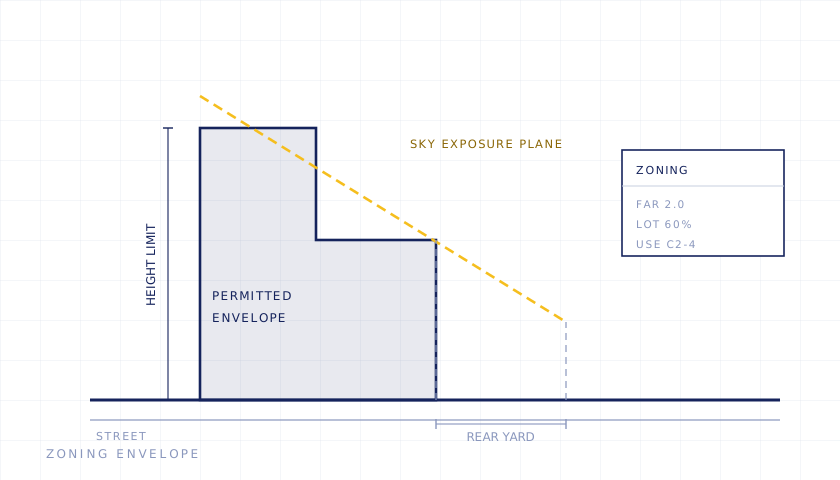
Suburban zoning is largely setbacks and coverage. City zoning is floor area ratio, use groups, the envelope and sky exposure plane, yards and lot coverage, plus whatever overlay or special district applies.
The first piece of work on most city projects is establishing what is permitted as-of-right and whether the certificate of occupancy on file supports the intended use. That analysis frequently determines whether a project is viable at all, and it is considerably cheaper than discovering the answer through an objection.
Professional certification and special inspections
A licensed professional engineer can seal drawings and file directly, including under professional certification where that is appropriate to the job. That keeps the analysis and the filing with the same person, so an objection is answered by whoever produced the calculations.
Special inspections are the other item that decides how a city job ends. They are identified and scheduled at filing, and where that is not done properly the job stalls at close-out rather than at review — which is the more expensive place to stall, because the work is already built.
Rarely just the Department of Buildings
Depending on scope, a city project can involve the fire department for suppression, alarm and place-of-assembly work; transportation for sidewalk sheds, scaffolding and street occupancy; environmental protection for site connections and asbestos matters; landmarks where the building or district is designated; and housing preservation where residential occupancy is involved.
Each has its own submission and its own timeline. They need to be sequenced deliberately rather than discovered one at a time.
Scope
- DOB NOW filings and submissions
- Zoning envelope and FAR analysis
- Alteration filings and scope determination
- Change of use and occupancy applications
- Certificate of Occupancy assistance
- Objection responses and agency coordination
Who we work with
Owners, tenants, developers and contractors working in the five boroughs.
Where we deliver this
Across Nassau, Suffolk, the East End and all five boroughs. Most requested in:
Related services
- Permitting & Expediting
- Violations, Open Permits & Compliance
- Certificates of Occupancy & Compliance
- Demolition & Change of Use
- Structural Engineering
- Design & Construction Documents
Related guides
- What to do when you get a building department violation
- Variances: when your project does not fit the zoning
Common questions
Why did my filing come back in objection?
Usually because the submission did not match what the examiner expected for that scope. Responding directly is faster than resubmitting blind.
What is the difference between Alt-1 and Alt-2?
Broadly, whether the certificate of occupancy changes. Which applies depends on the scope, and it is worth establishing before filing.
Can a professional engineer file in New York City?
Yes. A licensed PE can seal drawings and file directly with the Department of Buildings, including under professional certification where the job type permits it. For work with structural content that keeps the engineering and the filing together rather than splitting them between two firms.
Do I need a new certificate of occupancy for a fit-out?
Only if the use, occupancy or egress arrangement changes. A straightforward interior alteration that leaves the use group unchanged generally closes with a letter of completion instead. The determining document is the existing certificate — if it does not cover what you intend to do, the filing becomes a longer exercise, which is why it is the first thing checked.