
Service 23
Storm & Insurance Damage Assessment
Independent engineering assessment of storm, water, fire and impact damage.
After damage, the argument is usually about cause and extent. An engineering assessment establishes what failed, why, whether it is structural, and what the repair actually requires — in a form an insurer or adjuster has to engage with.
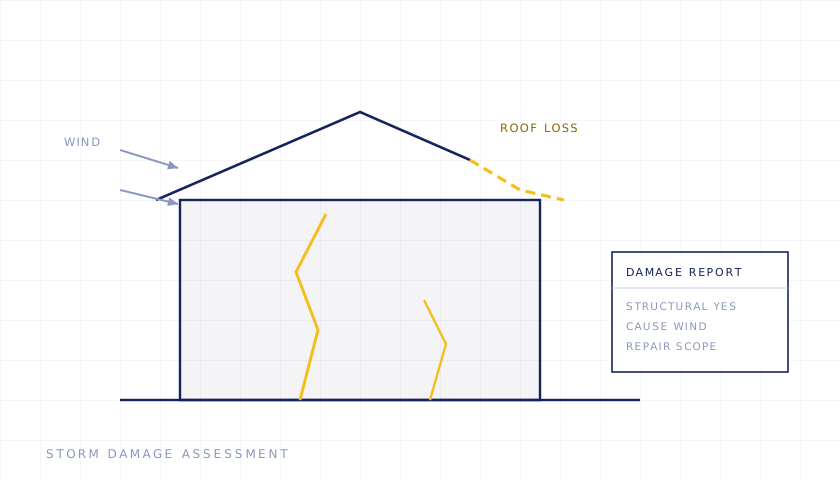
What an independent assessment is for
After storm, water, fire or impact damage the central questions are what actually failed, what caused it, and what it takes to put right. Those are engineering questions, and answering them properly requires someone examining the structure rather than estimating from photographs.
The role here is to establish the facts and state them in a sealed report. Not to argue a position — a report that reads as advocacy is worth less to everyone, including the person who commissioned it, than one that documents what is there.
Cause and origin is usually the contested part
Damage is rarely ambiguous. Its cause frequently is. Distinguishing a failure caused by a specific event from long-term deterioration, deferred maintenance, original construction defect or progressive movement is the technical core of the work, and it is what the report has to support.
Typical questions: whether cracking is new or pre-existing, whether water entry came from wind-driven rain or from a failed detail, whether a member deflected under an event load or has been creeping for years, and whether a foundation issue is recent settlement or original construction.
What the report contains
- Description of the structure and the conditions observed
- Photographic documentation tied to specific locations
- Measurements and, where relevant, structural analysis of the affected members
- Findings on cause, distinguishing event-related damage from pre-existing condition
- The repair scope required to return the structure to a compliant condition
- Sealed conclusions under a professional engineering license
Timing matters more than people expect
Evidence degrades. Temporary repairs get made, debris gets cleared, water dries and the conditions that would have established cause disappear. An assessment carried out early captures the structure closer to its post-event state, which makes the findings substantially easier to support.
Where emergency repairs are unavoidable for safety, documenting the condition beforehand — even briefly, even photographically — preserves what would otherwise be lost.
Scope
- Structural damage inspection and documentation
- Cause and origin analysis
- Wind, water, fire and impact damage evaluation
- Photographic documentation and written findings
- Repair scope and structural remediation design
- Sealed reports for insurance claims
- Support during claim review
Who we work with
Owners, property managers, public adjusters and insurers.
Where we deliver this
Across Nassau, Suffolk, the East End and all five boroughs. Most requested in:
Related services
- Forensic Engineering
- Engineering Reports & Certifications
- Inspections & Site Observation
- House Lifting & Flood Elevation
- Structural Engineering
- Property File Review
Related guides
Common questions
My claim was denied. Is an engineering report useful?
Often, yes. A denial frequently turns on cause or on whether damage is structural — both of which are engineering questions with documentable answers.
How soon after damage should the inspection happen?
As early as practical, before repairs disturb the evidence. Photograph everything in the meantime.
Do you work for the owner or for the insurer?
The engineering findings are the same either way, which is the point of an independent assessment. The report documents what was observed, what caused it and what repair the structure requires. It is prepared to be defensible on its own terms rather than to support a predetermined position.
How soon after the damage should the inspection happen?
As early as is safe. Evidence degrades quickly — temporary repairs, clearing and drying all remove conditions that help establish cause. Where urgent repairs cannot wait, photographing and documenting the condition first preserves most of what an assessment would otherwise rely on.