
Guide
Flood zones and house lifting on the South Shore
Reviewed
The zone your parcel sits in decides the foundation. The scope of your project decides whether you have a choice.
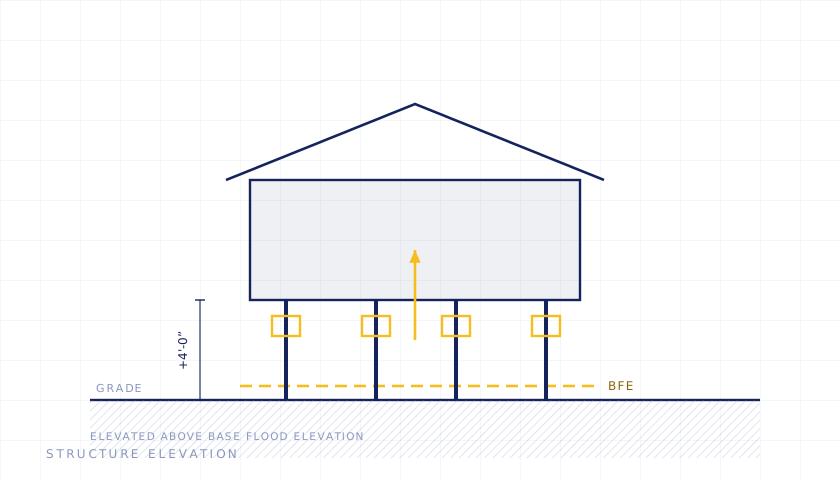
On the South Shore, the barrier islands and the bay and canal communities, the flood ordinance sits alongside the building code in most applications. Understanding two things — which zone you are in and whether your project triggers full compliance — explains almost everything else.
Reading the zone
Flood mapping assigns each parcel a zone, and the distinction that matters most is between the ones carrying wave action and the ones that do not.
- VE zones are coastal areas subject to wave action. Structures must sit on an open foundation — piles or columns — designed for wave forces, with the lowest horizontal structural member above the design flood elevation and no obstruction below it. Solid walls below that level are not permitted except as breakaway construction.
- AE zones are areas of the base flood without wave action. Solid foundation walls are permitted, but enclosed space below the design flood elevation requires flood venting to let water pass through rather than push against the wall, and the lowest floor governs compliance.
- X zones sit outside the mapped special flood hazard area. Flood requirements generally do not apply, though this does not mean the property cannot flood.
Zones are mapped per parcel and boundaries can run through a property. The governing figure is the one the mapping returns for your specific site, not a general figure for the neighbourhood.
Base flood elevation and freeboard
Base flood elevation is the height floodwater is expected to reach in the base flood. Freeboard is the additional margin the code and the local ordinance require above it — a safety factor, and one that local jurisdictions can and do set higher than the minimum.
Together they set your required finished floor height, and that ripples outward: into building height compliance under the zoning, into stair geometry and the number of risers, into how the entry and driveway work, and into flood insurance rating, which is driven directly by elevation relative to base flood elevation.
What triggers full compliance
This is the calculation that decides whether you are renovating or elevating.
Where work on an existing structure in a mapped flood zone crosses the substantial improvement threshold — a comparison between the cost of the work and the value of the structure — the flood provisions apply to the entire building rather than only the new work. The same applies where a structure has sustained substantial damage, assessed against the cost to restore it.
Below the threshold, only what you are building has to comply. Above it, the whole house does, which frequently means elevation. Running that calculation before the scope is fixed is the single most useful thing to do early, because the answer can redefine the project entirely — and because a scope sitting just under the threshold is a very different budget from one just over it.
What lifting actually involves
Raising a house is a sequenced structural operation:
- Assessing whether the existing framing can take being lifted at all — on older houses this is a real question, not a formality
- Temporary support and the load transfer while the structure is off its foundation
- A new foundation designed for the zone: piles or columns in VE, walls with venting in AE, and in both cases sized for the soil
- Mechanical, electrical and plumbing raised above the design flood elevation — equipment below it is a compliance failure as much as a practical one
- Stairs, entry, deck, driveway and utility connections all redesigned around the new floor level
The parts owners underestimate are consistently the ones outside the house.
The elevation certificate
Prepared from survey data after the work, it records the building’s elevations relative to base flood elevation. It evidences compliance and it is what flood insurance rating is based on. It is required for new and elevated construction and routinely requested at sale or refinance. Coordinating it is part of the job — a completed elevation without the certificate leaves the owner without the thing the exercise was for.
The unfiled work problem
A great deal of repair and reconstruction happened along the South Shore after 2012 and a meaningful proportion was never permitted. It surfaces at sale, at refinance, or when a violation is issued. Resolving it means documenting what was built, testing it against the flood provisions and current code, and filing to close the record — which is considerably easier before a closing date exists.
Common questions
How do I find out what flood zone I am in?
It is read from the flood mapping for your specific parcel rather than for the area, because boundaries can run through a property. The zone, the base flood elevation and the local freeboard requirement together determine what the design has to achieve, and all three are established at the outset.
Do I have to elevate my house?
Only if your project crosses the substantial improvement or substantial damage threshold, which compares the cost of the work against the value of the structure. Below it, only the new work must comply. Above it, the flood provisions apply to the whole building. That calculation belongs before the scope is fixed rather than after.
What is the difference between an AE and a VE zone?
Wave action. VE zones are subject to it, so the structure sits on an open foundation with the lowest horizontal structural member above the design flood elevation and nothing obstructing below. AE zones permit solid foundation walls but require flood venting, and compliance is measured to the lowest floor rather than the lowest structural member.
Will elevating reduce my flood insurance?
Elevation relative to base flood elevation is the main driver of flood premiums, so it generally does. The rating is made against the elevation certificate produced after the work, so the actual figure comes from your insurer rather than from the design.
Related services
- House Lifting & Flood Elevation
- Structural Engineering
- Storm & Insurance Damage Assessment
- Engineering Reports & Certifications