
Guide
Pool permits on Long Island: what actually gets reviewed
Reviewed
The structure is rarely the difficulty. The barrier, the bonding and the setbacks usually are.
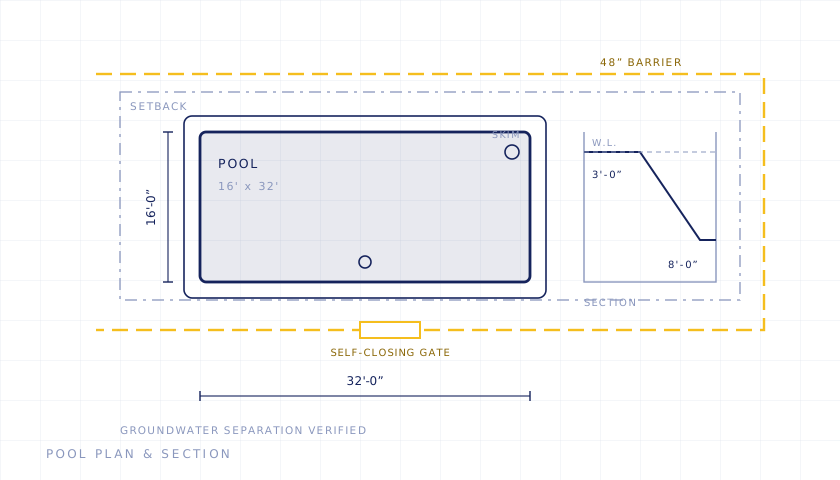
Pool applications are refused or delayed for a fairly narrow set of reasons, and almost none of them concern the pool itself. The pool is engineered by its manufacturer or installer. What the department reviews is everything around it.
The barrier is the first thing looked at
Every jurisdiction requires a pool to be enclosed, and barrier requirements are the most consistently enforced part of a pool filing because they exist for one reason. What gets checked:
- Barrier height, and the absence of any gap beneath it that would allow a child through
- Absence of climbable features on the outside face — horizontal rails, adjacent structures, the air conditioning unit that ends up next to the fence
- Gates that are self-closing and self-latching, opening away from the pool, with the latch positioned out of reach
- Where a wall of the house forms part of the barrier, alarms or self-closing devices on the doors giving onto the pool
- For above-ground pools, whether the ladder can be removed or secured, and whether the pool wall itself qualifies as the barrier
This is also where post-installation enforcement concentrates. A pool that passed inspection and later had a gate spring removed is a live compliance issue.
Electrical bonding is the item most often missed
Bonding ties the metal components in and around the pool — the shell reinforcement, ladders, handrails, pumps, and the deck reinforcement within a defined distance — into a common electrical path, so that no dangerous voltage difference can develop between two things a swimmer might touch at once.
It is not the same as grounding, it is inspected separately, and it has to be observed before the deck is poured. Getting to that stage without the bonding inspection scheduled is one of the more expensive sequencing errors available on a pool project.
Zoning: setbacks, coverage and what counts
Pools have their own setback requirements, frequently different from those for a building, and they generally count toward lot coverage. So does the surrounding deck or patio, which is the part owners forget.
On a constrained lot, coverage is often what determines whether the pool fits — and the answer can change depending on whether the decking is counted as impervious. Establishing that first prevents a design that has to shrink after submission.
Drainage, backwash and the water itself
Departments look at where water goes: pool discharge, backwash from filtration, and the increased runoff from the surrounding hard surface. Depending on the jurisdiction, drywells or a defined discharge arrangement may be required.
In unsewered parts of Suffolk there is an additional consideration, because a pool and its decking sit near the sanitary system and its expansion area, and the separation between them is reviewed. On a smaller lot this can be the binding constraint rather than zoning.
Structural questions that do arise
Where the site is not flat, retaining structures around a pool are engineering rather than landscaping and need design. On sloping ground the pool shell itself may need to account for unbalanced soil pressure. And a pool above or adjacent to a structure — on a deck, on a roof, over a basement — is a straightforwardly structural problem, because water is heavy and the load is permanent.
Unpermitted pools
Pools are visible from aerial imagery, which makes them one of the easier unfiled structures for a municipality to identify. Legalizing one after the fact means documenting the installation, demonstrating barrier and bonding compliance — the second of which is difficult once the deck is poured — and filing it. Where bonding cannot be evidenced, the remedy can be substantial.
Common questions
Do above-ground pools need a permit?
In most Long Island jurisdictions yes, though requirements are lighter than for in-ground. Barrier and electrical requirements still apply, and the pool wall may or may not qualify as the barrier depending on its height and the ladder arrangement. Thresholds vary by town and village.
What is bonding and why does it matter so much?
Bonding ties the metal components in and around the pool into a common electrical path so that no dangerous voltage difference can develop between two things a swimmer touches at once. It is inspected separately from grounding and has to be observed before the deck is poured — which is why the sequencing matters as much as the work.
Does a pool count toward lot coverage?
Generally yes, and so does the surrounding deck or patio, which is the part most often overlooked. On a lot already near its coverage limit, that calculation frequently decides the size of the pool before anything else does.
I bought a house with an unpermitted pool. What now?
It is documented, assessed against current requirements and filed. Barrier compliance is usually demonstrable. Bonding is the harder one, because the evidence is buried under the deck — and where it cannot be shown, the remedy can be significant. Worth establishing early rather than at the point of sale.