
Service 13
Pool Design & Permitting
In-ground pool plans, drainage, barrier compliance and the filings that go with them.
A pool permit pulls in far more than the pool. Groundwater separation, drainage, barrier and gate compliance, setbacks and the surrounding site work all get reviewed together — and across much of Long Island the water table sits close enough to drive the design.
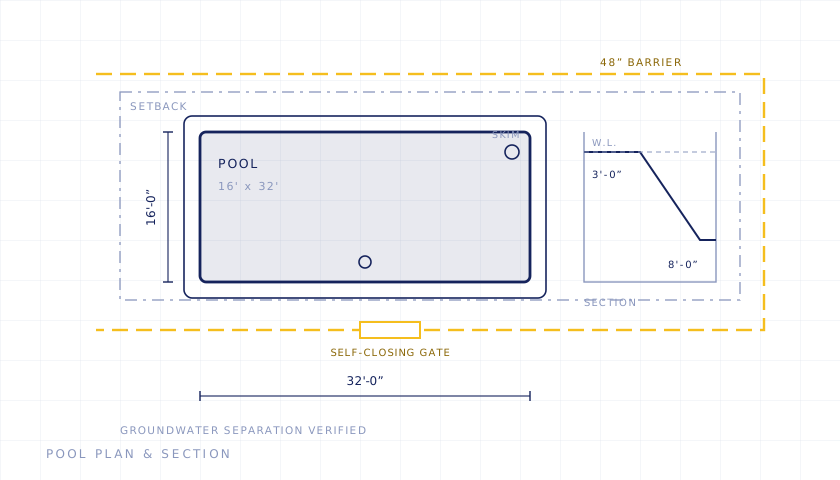
The pool is rarely the difficult part
Pool applications are delayed for a narrow and predictable set of reasons, and almost none of them concern the pool shell. It is engineered by its manufacturer or installer. What gets reviewed is everything around it — the barrier, the electrical bonding, the setbacks, and where the water goes.
Barrier and bonding
The barrier is the most consistently enforced element of a pool filing. Height, absence of any gap beneath, no climbable features on the outside face, and gates that are self-closing and self-latching with the latch out of reach. Where a wall of the house forms part of the enclosure, the doors onto the pool come into scope.
Electrical bonding ties the metal components in and around the pool into a common electrical path, so no dangerous voltage difference can develop between two things a swimmer touches at once. It is separate from grounding, inspected separately, and has to be observed before the deck is poured. Reaching that stage without the inspection scheduled is the most expensive sequencing error on a pool project.
Zoning and coverage frequently decide the size
Pools carry their own setback requirements, often different from those for a building, and they generally count toward lot coverage — as does the surrounding deck or patio, which is the part owners forget. On a lot already close to its limit, that calculation determines the size of the pool before any other consideration does.
Drainage, and sanitary in Suffolk
Departments look at where the water goes: pool discharge, filter backwash, and the additional runoff from new hard surface. Depending on jurisdiction, drywells or a defined discharge arrangement may be required.
In unsewered parts of Suffolk there is a further constraint, because the pool and its decking sit near the sanitary system and its expansion area, and the separation between them is reviewed. On a smaller lot this binds before the zoning does.
When it becomes structural
On sloping ground, retaining structures around a pool are engineering rather than landscaping and need design, and the shell itself may have to account for unbalanced soil pressure. A pool above or adjacent to a structure — on a deck, over a basement, on a roof — is straightforwardly structural, because water is heavy and the load is permanent.
Scope
- In-ground pool plans and construction drawings
- Pool structural design and details
- Drainage and groundwater separation analysis
- Barrier, fencing, gate and safety code compliance
- Setback, coverage and zoning review
- Health Department coordination where required
- Pool house, patio and decking filings
- Site grading tied to the pool and yard
- Legalization of existing unpermitted pools
Who we work with
Homeowners and pool contractors across Nassau, Suffolk and the East End.
Where we deliver this
Across Nassau, Suffolk, the East End and all five boroughs. Most requested in:
Related services
- Civil & Site Engineering
- Permitting & Expediting
- Variances & Zoning Relief
- Structural Engineering
- Wetlands & Environmental Permitting
- Design & Construction Documents
Related guides
- Pool permits on Long Island: what actually gets reviewed
- What an open permit is, and how it gets closed
Common questions
What holds up pool permits most often?
Barrier and gate compliance, and drainage or groundwater separation. Both are designed for up front here.
My pool was never permitted. What now?
It can usually be legalized. The work is documenting what exists and testing it against current code.
What is the most common reason a pool application is delayed?
Barrier details and bonding. The barrier requirements are specific — height, gaps, climbability, gate hardware — and small departures get picked up. Bonding is the other one, and it has a sequencing trap attached: it must be inspected before the deck is poured.
I inherited an unpermitted pool. Can it be legalized?
Usually. It is documented and assessed against current requirements, and barrier compliance is normally demonstrable. Bonding is the harder item, because the evidence is under the deck — where it cannot be shown, the remedy can be significant. Better established before a sale than during one.