
Service 21
Wetlands & Environmental Permitting
Work near tidal and freshwater wetlands, buffers and environmentally regulated areas.
Near a wetland, two or three authorities can hold jurisdiction at once — the state, the town trustees, and the local building department. Establishing which apply, and in what order, is most of the work.
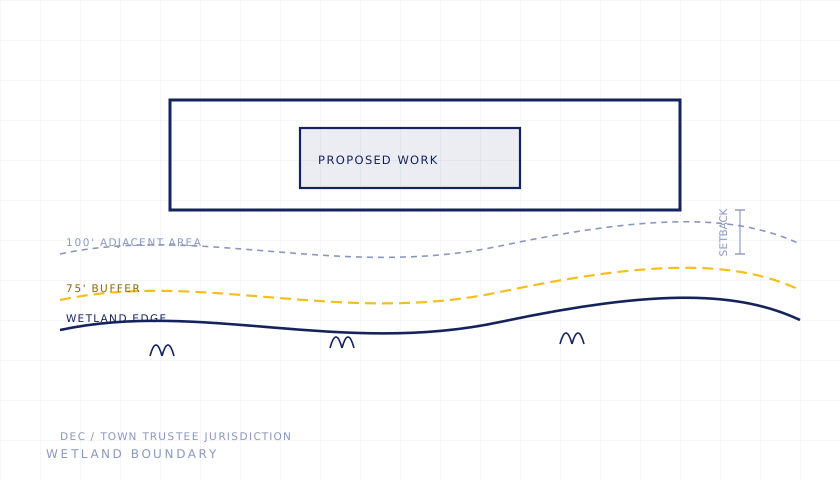
More than one authority usually applies
Wetlands jurisdiction on Long Island is layered. A single waterfront parcel can fall under town wetlands regulation, the town trustees, state environmental jurisdiction, and in coastal locations a coastal erosion hazard designation — each with its own application, its own criteria and its own meeting calendar.
They are not sequential by design but they frequently are in practice, because one body wants to see another’s determination before acting. Identifying which apply at the outset, and in what order, is most of what makes an environmental permitting timeline realistic.
The setback is measured from the wetland, not the property line
This is the point that most changes what an owner thinks they can build. Setbacks in wetlands jurisdiction are measured from the wetland boundary or the bluff crest, and that line frequently sits inside the property rather than at its edge.
The practical consequence is that the buildable envelope on a waterfront parcel is often substantially smaller than the lot suggests, and it has to be established before anything is designed. Where the boundary itself is uncertain, delineation comes first — because everything downstream is measured from it.
What tends to be reviewed
- Distance from the wetland boundary or bluff crest to any proposed structure or disturbance
- Clearing and vegetation removal, including within a buffer where one applies
- Stormwater and where runoff from new hard surface goes
- Sanitary arrangement and its separation from the wetland or groundwater
- Erosion and sediment control during construction
- On coastal parcels, whether anything is proposed seaward of a defined line
Where it interacts with everything else
Environmental permitting rarely sits on its own. On the East End and the North Fork it commonly runs alongside a zoning application, county health review of sanitary, and in some jurisdictions architectural or historic review — and the building permit waits on all of them.
That is why the sequencing matters more than the drawings. A project that establishes the buildable envelope first, then orders the applications so that each body has what it needs when it meets, finishes in one season rather than two.
Scope
- Wetland boundary and buffer analysis
- NYSDEC permit applications
- Town trustee and conservation board submissions
- Site plans showing regulated areas and setbacks
- Stormwater and erosion control design
- Coordination between state, town and building department review
- Mitigation and restoration planning
Who we work with
Waterfront and near-water property owners, East End projects, and builders working within regulated buffers.
Where we deliver this
Across Nassau, Suffolk, the East End and all five boroughs. Most requested in:
Related services
- Civil & Site Engineering
- Permitting & Expediting
- Variances & Zoning Relief
- Health Department Permitting
- Design & Construction Documents
- Additions & New Construction
Related guides
- Flood zones and house lifting on the South Shore
- Pool permits on Long Island: what actually gets reviewed
Common questions
How do I know if my property is regulated?
Mapped wetlands and their buffers can be checked against the parcel. Regulated areas often extend further inland than owners expect.
Can I build within a buffer?
Sometimes, with permits and often with conditions. Establishing jurisdiction early avoids designing something that cannot be approved.
How close to the water can I build?
It is measured from the wetland boundary or the bluff crest rather than the property line, and both town and state jurisdiction may set a setback. Establishing where those lines actually sit is the first step on any waterfront parcel, because the buildable envelope follows from it — and it is frequently smaller than the lot size suggests.
How long does wetlands permitting take?
Longer than a building permit, because several bodies are involved and each meets on its own calendar, often needing another’s determination first. Months rather than weeks is realistic. The drawings are rarely the constraint; the order the applications are made in usually is.