
Service 15
Project & Construction Management
Owner representation, scheduling and coordination from design through close-out.
On projects with several moving parts, delays come from the seams — between consultants, agencies and trades. Owner representation means one party holding the schedule and chasing the items that would otherwise sit.
What owner representation actually means
On most projects the owner is the least equipped party in the room and carries the most risk. Everyone else — contractor, subcontractors, suppliers — is working to their own scope and their own commercial interest. Owner representation is having someone on your side of the table who reads drawings, understands what is being claimed, and can tell whether a variation is genuine.
Where that person also produced the engineering, the difference is material: a change proposed on site gets evaluated against the design intent by whoever set it, rather than being accepted because nobody in the room can assess it.
Sequencing is the part that goes wrong
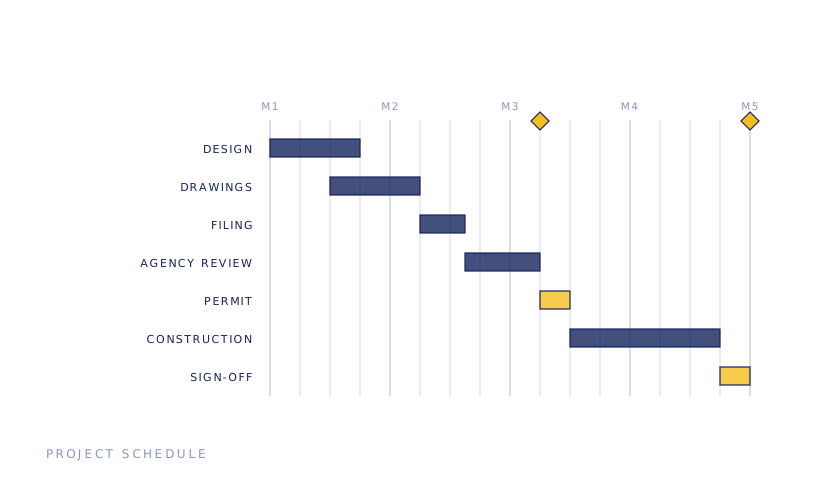
Most projects are not delayed by the work. They are delayed by things that had to happen before the work and did not:
- An approval on a meeting calendar that was missed by a week and cost a month
- A county health review that nobody put on the program
- An inspection not called before the work was concealed, so it comes back open
- A long-lead item ordered after the trade needed it
- A second agency — fire, transportation, environmental — discovered mid-project
These are all knowable in advance. Building the program backward from the approvals rather than forward from the construction is most of what avoids them.
Tracking conditions, not just tasks
Approvals are routinely granted subject to conditions, and those conditions are where projects fail at close-out rather than at start. A permit issued with three conditions attached, two of which nobody recorded, becomes a certificate that cannot be obtained six months later with the building finished.
Every condition, special inspection and outstanding item gets tracked from the point it is imposed through to the point it is discharged. That is unglamorous administration and it is the difference between a job that closes out and one that lingers.
Where this is worth having
Not on every project. It earns its place where there are multiple agencies involved, where the schedule has a commercial deadline attached — a lease commencement, a closing, a season — where the owner is not local, or where the work is complex enough that a variation is hard to assess from the outside.
Scope
- Project strategy, sequencing and scheduling
- Owner representation
- Coordination across consultants, agencies and trades
- Submission, approval and condition tracking
- Construction administration and site observation
- Budget and change order review
- Proactive issue resolution and reporting
Who we work with
Owners, developers and lenders who need someone accountable for delivery.
Where we deliver this
Across Nassau, Suffolk, the East End and all five boroughs. Most requested in:
Related services
- Construction Cost Estimating
- Inspections & Site Observation
- Design & Construction Documents
- Permitting & Expediting
- Additions & New Construction
- Structural Engineering
Related guides
- Restaurant build-outs: the timeline nobody plans for
- What a property file review tells you before you buy
Common questions
What does owner representation actually cover?
Holding the schedule, chasing the approvals and coordinating the parties, so that no item sits because everyone assumed somebody else owned it.
Can you manage a project you did not design?
Yes, though a review of the existing documents comes first.
How is this different from what my contractor does?
A contractor manages their own scope and their own trades, which is what they should do. Owner representation sits on the other side of that relationship — reviewing what is proposed, assessing variations against the design, and tracking the approval and inspection obligations that sit with the owner rather than the builder.
When is it worth engaging someone for this?
When several agencies are involved, when there is a commercial deadline attached to completion, when you are not local to the site, or when the project is complex enough that you cannot independently judge whether a change proposed on site is reasonable. On a straightforward job with a trusted builder, it is usually not necessary.